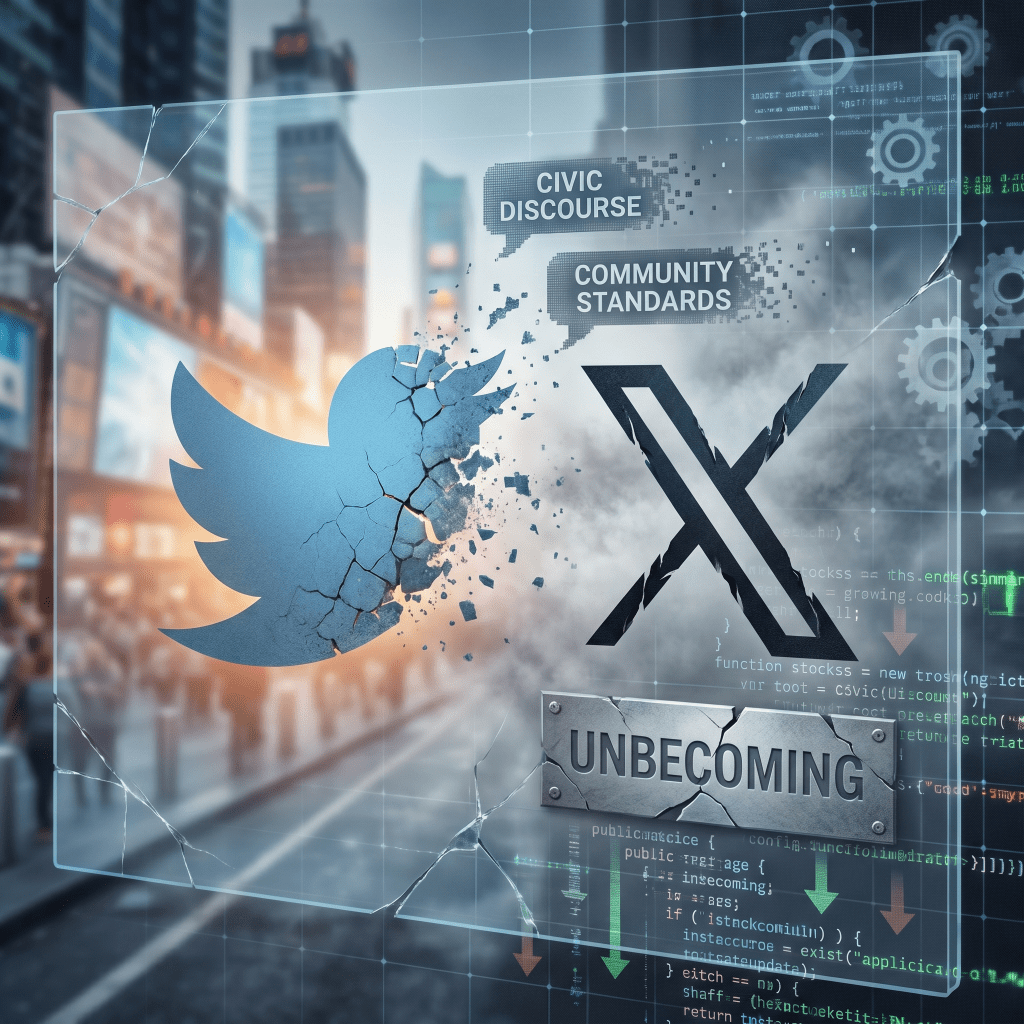
Over the past year, the story of X (formerly Twitter) has been told through a familiar set of narratives: erratic leadership, controversial policy decisions, declining trust, and an ongoing exodus of users. Each new change—whether to moderation policies, verification systems, or algorithmic visibility—has been treated as another turning point in the platform’s apparent decline.
But focusing on any single decision risks missing the larger transformation underway.
In recent work, Zizi Papacharissi and I describe this process as unbecoming—not only a diagnosis of misalignment, but a call to undo the logics that produced it.
What we are witnessing is not simply the deterioration of a platform. It is the unraveling of a particular model of digital social life.
For many users, X no longer functions as it once did. Communities have fragmented, norms have shifted, and practices that once relied on shared visibility and mutual recognition have become increasingly difficult to sustain. This is especially true for spaces like Black Twitter, where cultural expression, political critique, and collective witnessing depended on a fragile set of platform conditions—conditions that are no longer reliably in place.
These changes are often framed as failures: of leadership, of governance, or of moderation. But what if they are better understood as a process of unbecoming?
Unbecoming names a misalignment between technological systems and the social worlds they claim to support. It is not simply that a platform “fails” or “declines,” but that it gradually becomes inappropriate to the practices, communities, and values that once made it meaningful. Technologies that amplify harassment, privilege extraction over participation, or erode contextual forms of visibility are not just flawed—they are unbecoming of the social life they host.
Seen this way, the current fragmentation of X is not an isolated crisis. It is evidence of a deeper structural tension.
Platforms are often designed to scale—to maximize engagement, capture attention, and generate value through data extraction. But the social practices that make platforms meaningful do not scale in the same way. They rely on context, shared norms, and forms of accountability that are difficult to maintain under conditions of algorithmic amplification and rapid growth.
This tension is not new, but it has become increasingly visible.
As users disperse across alternative platforms—Threads, Bluesky, and others—we are seeing attempts to recover some of what has been lost: smaller networks, different moderation models, renewed attention to community norms. Yet these migrations also reveal a persistent problem. New platforms often reproduce the same underlying logics, even as they promise something different.
If this is the case, then the question is not simply whether X can be fixed.
It is whether the platform model itself—defined by scale, monetization, and centralized control—is capable of sustaining the kinds of social, cultural, and political practices it has come to host.
This is where the concept of unbecoming does its most important work. It shifts the focus from moments of crisis to processes of transformation. Platforms do not suddenly fail; they become misaligned over time. And once that misalignment reaches a certain threshold, reform efforts—however well-intentioned—may struggle to restore what has been lost.
The implications extend beyond any single platform.
Policy debates continue to focus on moderation, transparency, and accountability—important issues, to be sure. But if the underlying model remains unchanged, these interventions may only address the symptoms rather than the cause. What is at stake is not just how platforms are governed, but whether they are the appropriate infrastructure for digital public life in the first place.
The fragmentation of X, then, is not simply an ending.
It is a signal.
It points to the limits of platformization as a dominant way of organizing online social life, and to the need for alternative approaches that are better aligned with the communities they seek to serve. What those alternatives might look like remains an open question—but it is one that can no longer be deferred.
References
Adeyemo, B., & Papacharissi, Z. (2026). Unbecoming: Twitter and a Better Sociotechnical Future. M/C Journal, 29(2). https://doi.org/10.5204/mcj.3249

